
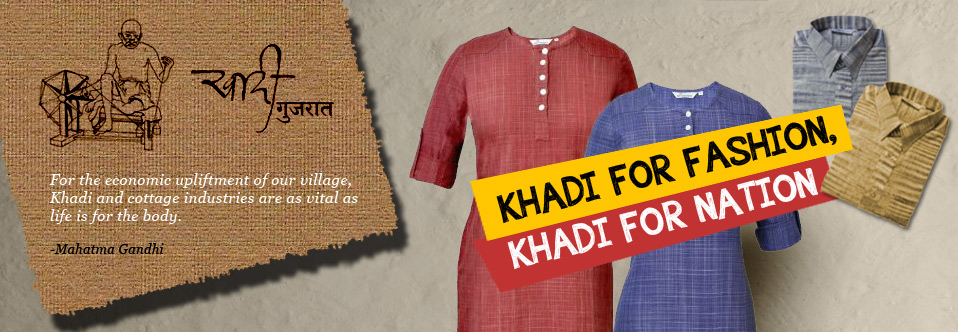
Khadi refers to hand-woven and handspun cloth which primarily made out of cotton but also includes silk and woolen fabrics. It is also well-known as “Khaddar” in Bangladesh and Pakistan. It is one of the versatile fabrics that remain cool in summers and warm in winters. These days government have been struggling hard to bring the existence and utility of Khadi back among all age groups making it a fashion statement. This matter wouldn’t have risen, if the German company has not trademarked khadi and Indian authorities located within the embassies noticed the same.

Khadi came into existence by the Swadeshi movement which was started by Mohandas Karamchand Gandhi after promoting the spinning of khadi as later he started wearing only dhoti. This movement promoted an ideology of self-weaving the cotton clothes and to get relived from the high prices on the clothes and goods that were sold in India by the British. The main motive of the khadi moment was to boycott foreign goods and clothes for the improvement of the Indian economy. The British being the rulers of the country used to purchase cotton from India at cheap prices and after manufacturing them into clothes, they used to bring it back in India and further sell at heavy prices.
Prime Minister Narendra Modi is the one renowned personality who carries the khadi in the most fashionable way and apt to become the Brand Ambassador of the Khadi. He had taken the initiative to dress the staff of the Air India and apart from that PMO office have ordered around 377 khadi apparels and around 10,000 khadi handmade paper files. Seeing this, many universities, schools and other office are heading towards to make khadi popular as uniform or mandatory fabric. Khadi mark is the new quality assurance symbol that has been developed.
Vinai Kumar Saxena, chairman of KVIC (Khadi & Village Industries Commission), said ‘Azadi ke pehle khadi for nation and azadi ke baad khadi for fashion’, (‘Khadi for the nation before Independence, khadi for fashion after Independence.’). The sales of the khadi products have increased from 2014-15 and is estimated to reach around $ 141 billion by the end of the 2021.
Sunil Sethi, the president of the FDCI said- “The Fashion Design Council of India (FDCI) and the entire designer fraternity have been bullish about khadi. We take khadi to be the fabric of the nation and have made it a part of our collections and shows whenever possible”. He further added- “Designers like Rajesh Pratap Singh, Samant Chauhan, Rohit Bal, Amit Arora, Anju Modi and many more are all part of the initiative to revive the textile in the country and globally.”

Ritu Beri, renowned fashion designer of India who was appointed as the advisor to KVIC in March, where she has the plans to widen its appeal overseas and bring an extra finesse to khadi products.
Ritu Beri said- “I would love to work on designs with khadi that will be accepted globally. I would advise an introduction of state-of-the-art designs and styles in khadi readymade garments and make khadi a global fabric beyond just India”. She further added- “We plan to do lots of initiatives, including fashion shows showcasing khadi creations. We plan to do shows for kids and adults in khadi. We will be doing impressive promotions and exhibitions related to khadi”.
She wants to broaden the reach of khadi both locally and globally with the help of expertise and experience that she has in designing clothes. Youngsters find khadi unfashionable and boring as it associated with the leaders, educators, traditional artists and politicians. She further added- “We shall try to take khadi to colleges and universities. I would like clothes designed in khadi by global designers which are trendy with cutting-edge designs at par with the global designs and brands”.
Verdict: Khadi is the versatile fabric and is not mere a piece of cloth but a way of life. I personally find this fabric very sophisticated and comfortable and love to use it in forms of kurti’s, shirts and sarees. If you take the history and its inventions as boring and uninteresting, you will not be able to bring the change in the society. Change is the continuous and therefore we require changes too. If changes are done keeping the current situations in mind, it will make us feel refreshed and at the same maintain the essence of the tradition.
Author: Viveka Nagar